Astrology Library
Explore the rich history, philosophy, and foundations of astrology — written for curious newcomers and seasoned practitioners alike.
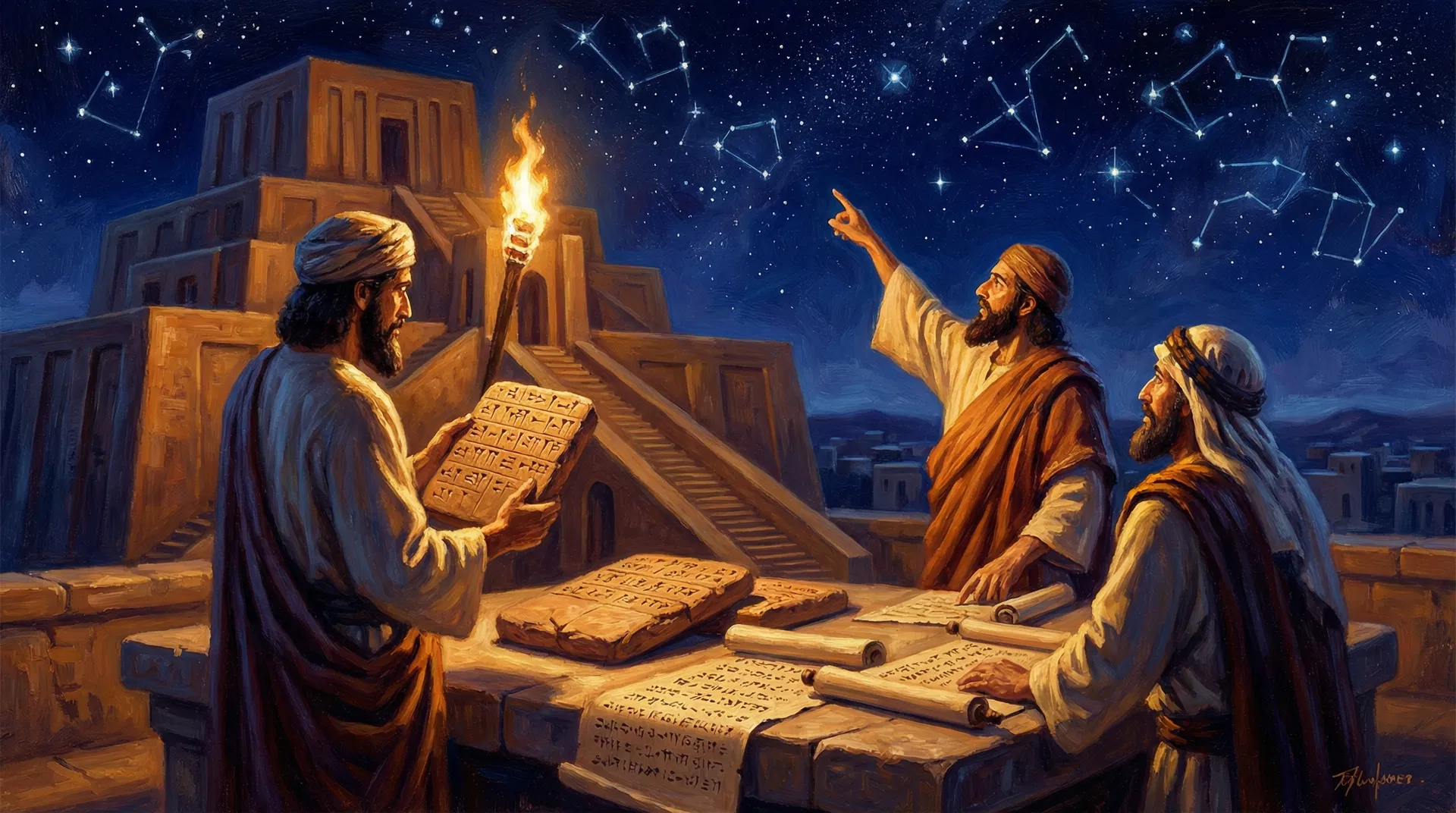
Ancient Babylonian astronomers charting the heavens
The Cosmic Dance Through Time: A Journey Through the History of Astrology
Welcome, cosmic voyager, to a journey through the ancient and enduring art of astrology! For millennia, humanity has looked to the heavens, seeking meaning, guidance, and understanding of our earthly existence. Astrology, in its essence, is the study of the correlation between celestial movements and events on Earth, including human affairs and natural phenomena. It's a profound tradition, rich with history, philosophy, and a deep reverence for the interconnectedness of all things.
The Dawn of Cosmic Observation: Ancient Mesopotamia (c. 3rd Millennium BCE)
Our story begins in the fertile crescent of Mesopotamia, particularly with the Sumerians, Akkadians, Assyrians, and Babylonians. These ancient civilizations were meticulous sky-watchers, driven by both practical needs (like agriculture and calendrical tracking) and a profound spiritual belief that the heavens were the domain of the gods.
Initially, their observations, recorded on cuneiform tablets, focused on mundane astrology – predicting events for kings, nations, and the weather. They developed sophisticated mathematical systems to track planetary movements and eclipses, believing these celestial events were omens from the deities. The concept of the zodiac, a band of constellations through which the Sun, Moon, and planets appear to travel, also began to take shape here, albeit in a more observational, less individualized form than we know it today.
The Hellenistic Revolution: Birth of Natal Astrology (c. 4th Century BCE - 1st Century CE)
The knowledge of Mesopotamian astronomy and omen interpretation spread, notably influencing the Egyptians and then the Greeks. It was during the Hellenistic period, following the conquests of Alexander the Great, that astrology underwent a profound transformation.
In the melting pot of Alexandria, Egyptian wisdom, Babylonian astronomical data, and Greek philosophical inquiry converged. This era saw the birth of natal astrology – the practice of casting a birth chart (horoscope) based on the precise moment and location of an individual's birth. Key concepts solidified during this time include:
- The Twelve Astrological Houses: Divisions of the sky representing different areas of life.
- Planetary Rulerships: Assigning specific planets to signs and houses.
- Aspects: Angular relationships between planets in a chart, indicating dynamic interactions.
Influential figures like Ptolemy, with his seminal work Tetrabiblos, systematized much of Hellenistic astrology, laying down principles that would endure for centuries. Astrology became deeply intertwined with philosophy, medicine, and mathematics, seen as a legitimate and essential field of study.
The Golden Age of Islamic Astrology (c. 8th - 13th Centuries CE)
As the Roman Empire declined, much of Hellenistic knowledge, including astrological texts, was preserved and further developed by Islamic scholars. During the Islamic Golden Age, astrology flourished, with astronomers and astrologers making significant advancements.
They meticulously translated and commented on Greek and Persian texts, refined astronomical instruments, and developed more precise computational methods. Figures like Albumasar (Abu Ma'shar) were highly influential, integrating Persian and Indian astrological concepts into the Hellenistic framework. Islamic astrologers applied their craft to various fields, from medicine and architecture to predicting political events, demonstrating its pervasive influence.
Astrology in the European Renaissance (c. 14th - 17th Centuries CE)
Through translations from Arabic into Latin, astrological knowledge re-entered Western Europe, sparking a resurgence of interest during the Renaissance. Astrology was widely practiced by scholars, physicians, and even popes and monarchs. Universities taught astrology alongside medicine and astronomy.
Notable figures like Johannes Kepler, the famous astronomer, also practiced astrology, seeking to understand the "harmonies of the world." However, this period also saw the seeds of its eventual separation from astronomy, as the Scientific Revolution began to emphasize empirical observation and mathematical proof in a way that challenged astrology's more symbolic and interpretive nature. The shift from a geocentric (Earth-centered) to a heliocentric (Sun-centered) model of the solar system, while not directly invalidating astrological principles, did alter the cosmological framework within which it operated.
The Age of Enlightenment and Modern Revival (18th Century - Present)
The Enlightenment brought a strong emphasis on reason and empirical science, leading to astrology's decline in academic circles. It was increasingly viewed as superstition rather than science. For a time, it retreated to the fringes, sustained by popular almanacs and a persistent, if less scholarly, interest.
The late 19th and early 20th centuries witnessed a revival of esoteric traditions, including astrology. The Theosophical Society and figures like Alan Leo played crucial roles in reintroducing astrology to a wider public, often emphasizing its psychological and spiritual dimensions. The development of psychological astrology in the mid-20th century, influenced by Jungian archetypes, further shifted its focus from predictive determinism to understanding personality and potential.
Today, astrology continues to thrive, particularly in the digital age. It is embraced by millions as a tool for self-discovery, personal growth, and understanding relationships. While still distinct from academic science, modern astrology often emphasizes its role as a symbolic language, a framework for introspection, and a means to connect with the ancient wisdom of the cosmos.
Why Astrology Matters Today
The history of astrology is a testament to humanity's enduring quest for meaning. It reminds us that:
- We are part of something larger: Astrology fosters a sense of connection to the universe, reminding us that we are microcosms reflecting the macrocosm.
- Self-understanding is a lifelong journey: A birth chart offers a unique symbolic map of our potential, challenges, and inner workings, encouraging introspection.
- Patterns and cycles exist: By observing celestial rhythms, astrology helps us recognize patterns in our own lives and navigate them with greater awareness.
From the star-gazers of ancient Babylon to the modern seeker exploring their birth chart online, astrology has consistently offered a lens through which to view ourselves and our place in the grand cosmic dance. It's a tradition that invites curiosity, wonder, and a deeper appreciation for the intricate tapestry of existence.